
Outboundry's MCP (Model Context Protocol) server lets compatible AI assistants such as ChatGPT, Claude, Cursor, and VS Code interact with your Outboundry workspace.
Once connected, you can ask your AI assistant to perform Outboundry tasks using natural-language instructions instead of manually navigating through the app. For example, you could ask your assistant to find leads who engaged with your outreach, create a follow-up campaign, or review and respond to conversations.
What is MCP?
MCP is an open standard that allows AI assistants to connect to applications and use their data and actions.
Outboundry provides an MCP server that allows compatible AI tools to securely access and operate within your Outboundry workspace.
You connect your AI assistant once, authorize the required access, and then use the assistant to work with Outboundry.
Note: Outboundry is the MCP server. You use a separate MCP-compatible AI client, such as ChatGPT, Claude, Cursor, or VS Code, to interact with it.
Before you start
Before connecting an AI assistant to Outboundry, make sure you have:
An active Outboundry account.
Access to the Outboundry workspace you want to connect.
An AI client that supports MCP and HTTP transport.
The appropriate permissions within your Outboundry workspace.
The Outboundry MCP server uses a single endpoint:
https://api.outboundry.com/api/v1/mcp
You can also copy the endpoint directly from the Outboundry MCP Settings page.
Step 1: Open MCP Settings
In Outboundry, go to:
Settings → Developer → MCP
You can also open the MCP Settings page directly.
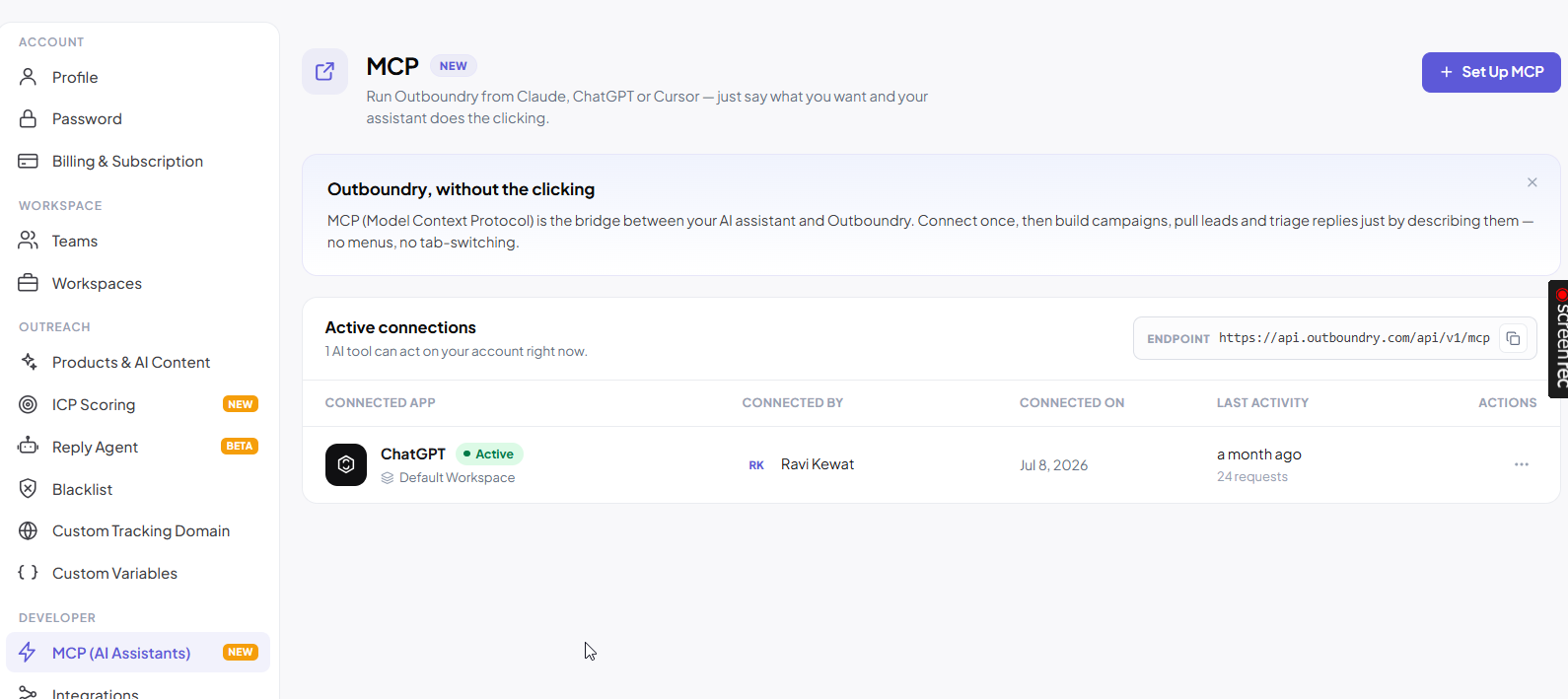
The MCP page provides:
An explanation of MCP
The Outboundry MCP endpoint
A button to copy the endpoint
Your active MCP connections
Connection status
Connected client
Workspace
Connected user
Connection date
Last activity
Request count
Options to reconnect or disconnect a connection
Step 2: Copy the MCP endpoint
Copy the Outboundry MCP endpoint from the MCP Settings page.
https://api.outboundry.com/api/v1/mcpThe same endpoint is used regardless of which supported AI client you're connecting or which Outboundry workspace you're using.
Step 3: Connect your AI assistant
Outboundry supports OAuth 2.1 for major MCP clients. If your MCP client doesn't support OAuth, you can use a workspace API key as a fallback.
Choose your AI client below for the setup instructions.
Connect ChatGPT
Availability: Pro, Team, or Enterprise
1. Enable Developer Mode
In ChatGPT, go to:
Settings → Apps and Connectors → Advanced
Enable Developer Mode.
2. Create a new app
Go to:
Settings → Apps and Connectors → Create app
3. Configure the app
Enter:
Name: Outboundry
Endpoint:
https://api.outboundry.com/api/v1/mcpAuthentication: OAuth
4. Authorize Outboundry
Click Create.
A browser window opens and takes you to the Outboundry authorization page.
Sign in to your Outboundry account if required and review the requested access.
Select the workspace you want to connect and click Authorize.
5. Start using Outboundry
Return to ChatGPT.
Once the authorization is complete, the Outboundry connection becomes available to ChatGPT.
Connect Claude
1. Open Connectors
In Claude, go to:
Settings → Connectors
2. Add a custom connector
Choose the option to add a custom connector.
3. Enter the Outboundry endpoint
Paste:
https://api.outboundry.com/api/v1/mcp
Click Connect.
4. Authorize the connection
A browser window opens.
Sign in to Outboundry, select the workspace you want to connect, review the requested permissions, and click Authorize.
Once authorization is complete, the Outboundry connection becomes available in Claude.
Connect Claude Code
Claude Code can connect to Outboundry from the terminal.
1. Add the MCP server
Run:
claude mcp add --transport http outboundry https://api.outboundry.com/api/v1/mcp2. Authorize Outboundry
A browser window opens.
Sign in to Outboundry and click Authorize after reviewing the requested access.
3. Start using the connection
Return to Claude Code. The Outboundry MCP server is now connected.
Connect VS Code
1. Open the Command Palette
Open the VS Code Command Palette.
Search for:
MCP: Add Server
2. Select HTTP transport
Choose HTTP as the transport type.
3. Enter the endpoint
Enter:
https://api.outboundry.com/api/v1/mcp
4. Authorize
When prompted, authorize the connection in your browser.
Sign in to Outboundry, select your workspace, review the requested permissions, and click Authorize.
The Outboundry MCP server is now connected to VS Code.
Connect Cursor
1. Open MCP settings
In Cursor, go to:
Settings → MCP
2. Add a new server
Click Add New Server.
3. Select HTTP
Choose HTTP and enter:
https://api.outboundry.com/api/v1/mcp
4. Authorize
When prompted, authorize the connection in your browser.
Sign in to Outboundry, select the workspace you want to connect, review the permissions, and click Authorize.
The Outboundry MCP server is now available in Cursor.
Connect another MCP-compatible client
If you're using an MCP client other than the supported clients above:
Add a new MCP server.
Select Streamable HTTP or HTTP transport.
-
Enter the Outboundry MCP endpoint:
https://api.outboundry.com/api/v1/mcp Use OAuth 2.1 if your client supports it.
If OAuth isn't supported, authenticate using an Outboundry workspace API key.
Complete the authorization process in your browser.
Important: HTTP transport is required. Clients that don't support streamable HTTP cannot connect to the Outboundry MCP server.
Authorize Your Connection
When an AI client connects to Outboundry, you'll be redirected to the Outboundry authorization page.
The authorization screen shows:
The AI client requesting access
The permissions being requested
The Outboundry workspace that will be connected
Review the information carefully before approving the connection.
Select the appropriate workspace and click Authorize.
Each MCP connection is associated with one specific workspace. A connection cannot access another workspace unless that workspace is separately authorized.
What can an AI assistant do with Outboundry MCP?
The MCP connection provides four main groups of capabilities.
View leads and contacts
The AI assistant can access:
Lead lists
Contact information
Enrichment data
Reply history
This allows you to ask questions about your prospects and use lead information while performing other tasks.
Create and manage campaigns
The AI assistant can:
Create campaigns
Build campaign sequences
Change campaign settings
Start campaigns
Pause campaigns
Send and schedule messages
The AI assistant can send and schedule:
Email messages
LinkedIn messages
Sending still follows Outboundry's existing sending rules and limits.
Read and manage inbox replies
The AI assistant can access conversations and:
Summarize replies
Draft responses
Reply to conversations
This allows you to use your AI assistant to help manage conversations in your Unified Inbox.
What MCP cannot do
MCP does not bypass Outboundry's existing permissions or sending safeguards.
It cannot exceed sending limits
Daily sending caps, warmup limits, scheduling windows, and mailbox-level throttles continue to apply.
For example, if an AI assistant is asked to send more emails than a mailbox's daily limit allows, Outboundry will enforce the applicable limit.
It cannot access other workspaces
Every MCP connection is tied to a specific Outboundry workspace.
If you want to connect another workspace, authorize a separate connection for that workspace.
It cannot exceed your Outboundry role
The MCP connection inherits the permissions of the user who authorized it.
For example, if your Outboundry role doesn't allow you to create campaigns, an AI assistant connected through your account won't be able to create campaigns either.
Managing Your MCP Connections
You can manage all your active MCP connections from:
Settings → Developer → MCP
The connections table shows information such as:
AI client
Workspace
Connected by
Connection date
Last activity
Request count
Connection status
This makes it easy to identify which AI tools currently have access to your workspace.
Connection Statuses
Active
The connection is authorized and working.
The AI client can access Outboundry according to the permissions of the connected user.
Needs Re-auth
The connection's authentication is no longer valid.
Click Reconnect to authorize the connection again.
Reconnect an MCP Connection
If a connection shows Needs Re-auth:
Go to Settings → Developer → MCP.
Find the affected connection.
Click Reconnect.
Complete the authorization process in your browser.
Once authorization is complete, the connection becomes active again.
Disconnect an MCP Connection
You can revoke an AI client's access to your workspace at any time.
Go to Settings → Developer → MCP.
Find the connection you want to remove.
Click the connection's action menu.
Select Disconnect.
Confirm the disconnection.
Disconnecting immediately revokes the connection's access to the workspace.
You can reconnect the AI client later if needed.
Using an API Key
OAuth 2.1 is the recommended authentication method because it provides a separately identifiable and revocable connection for each client and workspace.
If your MCP client doesn't support OAuth, you can use an existing Outboundry workspace API key as a fallback.
When using an API key:
The key is used as a bearer token.
The connection appears as Other tool because the API key doesn't identify a specific MCP client.
The API key is a long-lived credential, so treat it as a secret.
Recommendation: Use OAuth whenever your MCP client supports it.
Important Security Considerations
Only connect AI clients that you trust.
An authorized MCP connection can perform actions within the permissions available to the user who connected it.
Before authorizing a connection:
Verify the AI client you're connecting.
Confirm the correct Outboundry workspace is selected.
Review the permissions displayed on the authorization screen.
Disconnect integrations you no longer use.
Workspace administrators can view and revoke MCP connections from the MCP Settings page.
Troubleshooting
I authorized the wrong Outboundry account
If the authorization page opens while you're signed into the wrong Outboundry account, don't authorize the connection.
Switch to the correct account and restart the authorization process.
The authorization screen identifies the currently signed-in account to help you verify that you're connecting the correct user.
My connection shows "Needs Re-auth"
The connection's authentication token may have expired or been invalidated.
Go to:
Settings → Developer → MCP
Find the connection and click Reconnect.
I copied the endpoint but nothing happened
Copying the endpoint URL does not create a connection by itself.
You must add the endpoint to your MCP-compatible client and complete the authorization process.
My MCP client doesn't support OAuth
If your client supports MCP but doesn't implement OAuth 2.1, you can use a workspace API key as the authentication method.
Make sure the client supports Streamable HTTP.
My MCP client doesn't support Streamable HTTP
Outboundry MCP requires HTTP transport.
If your MCP client doesn't support Streamable HTTP, it cannot connect to the Outboundry MCP server.
I connected the same client twice
If you authorize the same client for the same workspace again, the newer authorization replaces the previous connection rather than creating a duplicate connection.
Can I connect the same AI client to multiple workspaces?
Yes.
Each workspace requires its own authorization. Each connection is independently scoped and can be revoked separately.
What happens if my Outboundry role changes?
Your MCP connection follows your current Outboundry permissions.
If your role is downgraded, the AI assistant's effective permissions are also reduced.
Frequently Asked Questions
Do I need to create an API key to connect ChatGPT or Claude?
No.
ChatGPT, Claude, Claude Code, VS Code, and Cursor support OAuth 2.1, so you can authorize the connection directly through Outboundry without manually handling an API key.
Is MCP available for all AI assistants?
Outboundry supports MCP-compatible clients that support the required HTTP transport. Setup instructions are currently available for ChatGPT, Claude, Claude Code, VS Code, Cursor, and other compatible MCP clients.
Can I use MCP to create campaigns?
Yes. The MCP connection can create and manage campaigns, build sequences, change campaign settings, and start or pause campaigns, subject to your Outboundry permissions.
Can MCP send emails and LinkedIn messages?
Yes. The MCP connection can send and schedule email and LinkedIn messages on your behalf.
Outboundry's normal sending limits, warmup requirements, scheduling windows, and mailbox throttles still apply.
Can MCP read my leads?
Yes. The connection can access lead lists, contact information, enrichment data, and reply history according to the permissions of the user who authorized it.
Can MCP manage my inbox?
Yes. The MCP connection can access conversations and help summarize, draft, and send replies.
Can one MCP connection access multiple workspaces?
No.
Each connection is scoped to exactly one workspace. To connect another workspace, authorize a separate connection.
Can I revoke access later?
Yes.
Go to Settings → Developer → MCP, find the connection, and select Disconnect.
The connection's access is revoked immediately.
Does MCP replace Outboundry's API or webhooks?
No.
MCP is designed for AI-assisted, conversational workflows. Outboundry's REST API and webhooks remain available for deterministic integrations and non-conversational automation.
Example prompts you can use
Once your AI assistant is connected to Outboundry, you can describe the task you want it to perform in natural language.
For example:
"Show me the leads who replied to my recent campaign."
"Create a follow-up campaign for the leads who haven't replied."
"Summarize my latest replies and identify the prospects who seem interested."
"Find the leads who opened my emails but haven't replied yet."
"Pause the campaign called [campaign name]."
"Draft replies to the conversations that need my attention."
The exact actions available to your AI assistant depend on the client's capabilities, your Outboundry permissions, and the data available in your workspace.
Best Practices
Start with a trusted AI client.
Use OAuth whenever available.
Start with Co-pilot-style or review-based workflows when you're testing AI-driven outbound actions.
Review the workspace and permissions before authorizing.
Monitor your MCP connections regularly.
Disconnect clients you no longer use.
Never share your workspace API key publicly or paste it into an untrusted application.
Remember that MCP does not bypass Outboundry's sending limits or your workspace permissions.